Walking on Long Island: The Pedestrian Safety + Legal Guide
A practical safety + legal guide for walkers on Long Island — the most dangerous intersections, NY pedestrian right-of-way rules, what to do if you're hit, and how to walk our worst roads more safely.

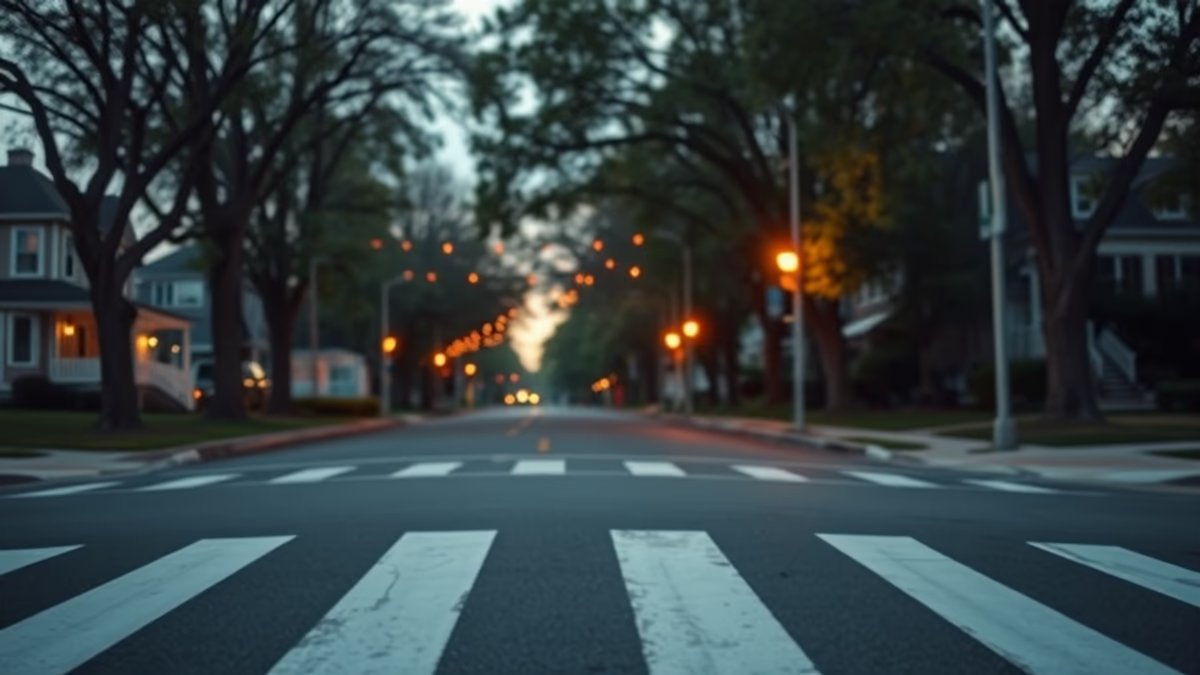
Why pedestrian safety on Long Island matters
Long Island ranks among the most dangerous metropolitan areas in the Northeast for walkers. The pattern is well-documented: wide arterial roads (Hempstead Turnpike, Sunrise Highway, Jericho Turnpike, Route 110), high speeds, few protected crossings, and a driving culture that consistently underweights pedestrian right-of-way. Suffolk County alone records 40-60 pedestrian fatalities in a typical year; Nassau adds another 20-30.
This guide pulls together what walkers, joggers, and parents of school-age children should know — the worst stretches to avoid when possible, the New York State rules that actually apply, what to do if you (or someone you witness) are hit, and the legal steps that matter most in the first 48 hours.
It is not legal advice. It’s the editorial team’s collected knowledge from years of covering Long Island traffic. For your specific situation, consult a licensed New York attorney.
The corridors to know about
Some Long Island roads are notably more dangerous for pedestrians than others. The most consistently flagged stretches in police data and news coverage:
South Shore
- Sunrise Highway (Route 27) — particularly the Sunrise Highway corridor through Patchogue, Bay Shore, Lindenhurst, and Massapequa. High speeds, frequent lane changes, long distances between safe crossings.
- Montauk Highway (Route 27A) — narrower than Sunrise but with fewer crosswalks and the added challenge of summer-traffic congestion.
- Hempstead Turnpike (Route 24) — Nassau’s most dangerous arterial for pedestrians. Multiple high-injury intersections in Hempstead, East Meadow, and Levittown.
North Shore
- Jericho Turnpike (Route 25) — particularly through Huntington Station, Commack, and Smithtown. Heavy commuter traffic, six lanes in some sections.
- Northern State Parkway access points — not the parkway itself (no pedestrians), but the on/off-ramp areas where drivers are accelerating onto the highway.
- Route 25A through Huntington Village + Northport — fewer fatalities but more pedestrian-injury incidents due to high foot traffic + village street parking.
East End
- Route 27 in the Hamptons — summer-traffic complications, narrow shoulders, peak risk during August.
- Riverhead Main Street — improvements have helped, but the East End gateway sees a lot of pedestrian traffic in a small area.
Specific high-injury intersections (recurring in police data)
- Hempstead Turnpike + N Franklin Avenue (Hempstead)
- Sunrise Highway + Carleton Avenue (Central Islip)
- Jericho Turnpike + Commack Road (Commack)
- Route 110 + Walt Whitman Road (Huntington Station)
- Hicksville Road + Old Country Road (Hicksville)
If you regularly cross any of these on foot, treat the legal “walk” signal as a starting point — not as confirmation it’s safe.
NY State pedestrian right-of-way rules (the short version)
New York Vehicle and Traffic Law Section 1151 establishes the basics. Here’s the practical interpretation:
Drivers MUST yield to pedestrians:
- In marked crosswalks when the walker is in the driver’s half of the road, or close enough to constitute danger
- In unmarked crosswalks at intersections — every intersection has implied crosswalks even when not marked
- When making a turn that would cross a pedestrian’s path on a green light
- When pedestrians have crossed legally on a “walk” signal and the signal changes mid-crossing — drivers must wait until they’ve finished
Pedestrians MUST:
- Use crosswalks where available — jaywalking outside crosswalks shifts liability toward the walker, but does NOT eliminate the driver’s duty of care
- Obey traffic control signals (walk/don’t walk signs)
- Not suddenly enter the road from a curb or other safe place into the path of a vehicle that’s too close to yield safely
- Walk facing traffic when no sidewalk is available, on the LEFT side of the road
What this means in a collision context
Even when a pedestrian violates a rule (crossing mid-block, against a signal, etc.), the driver is rarely fully off the hook. New York is a pure comparative negligence state — a pedestrian found 30% at fault for an accident can still recover 70% of their damages from the driver’s insurance. This is meaningfully different from states like Maryland (contributory negligence) where any pedestrian fault can eliminate recovery.
Defensive walking — what actually helps
Years of pedestrian-safety research has identified a small number of practices that meaningfully reduce risk. The ones that hold up on Long Island specifically:
Visibility
- Wear high-contrast clothing at dusk and night. Reflective strips on jackets, backpacks, dog leashes. This sounds basic; it is the single highest-ROI safety investment.
- Avoid earbuds in both ears when crossing roads. Hearing is your second-most-important defensive sense (after vision).
- Make eye contact with drivers at intersections before committing to a crossing. If you can’t see their face, they can’t see you.
Crossing strategy
- Cross only at intersections with traffic controls (signals or stop signs) when possible. The “convenience” of crossing mid-block to avoid a 200-foot detour isn’t worth the 6x risk multiplier.
- Wait for ALL lanes to be clear — don’t trust that an oncoming car has stopped because the one beside it has. Multi-lane stops are when most pedestrian fatalities happen.
- At signalized intersections, give yourself 2 seconds AFTER the “walk” signal appears before entering the crosswalk. Right-turning drivers often gun the corner during the first seconds of green.
Time-of-day awareness
- Dawn and dusk (the “low-sun” periods) are statistically the most dangerous times for pedestrians. Plan errands accordingly.
- Friday and Saturday evenings see elevated impaired-driving incidents. Cross with extra care after 9 PM on weekends.
Walking with kids
- Hold hands at all crossings until age 10, even on quiet residential streets. Children under 10 cannot reliably judge oncoming-vehicle speed.
- Walk the LEFT side facing traffic when on a road without sidewalks — gives you visual warning of oncoming cars.
- Teach kids the “stop-look-listen-look” routine for every street crossing, not just busy ones. Habit beats decision-making.
If you’re hit by a vehicle — the first 48 hours
If you’ve been involved in a pedestrian-vehicle collision, what you do (or don’t do) in the first 48 hours matters enormously — both for your physical recovery and for any legal or insurance claim that follows.
At the scene
- Stay still if you can’t be certain of injury. Adrenaline masks pain. Moving with an undiagnosed back or neck injury can compound damage. If a vehicle is in danger of being struck again (e.g., you’re in a live lane), move only as much as necessary to reach safety.
- Call 911. Always. Even if you “feel okay.” A police report is the single most important document for any subsequent claim, and an EMS evaluation is the easiest way to document the immediate injury context.
- Get the driver’s information: name, license, insurance, plate number. Photograph all of it.
- Photograph the scene before vehicles are moved: position of car, your starting point, the crosswalk or intersection, any debris, your visible injuries.
- Witnesses: ask anyone nearby for name + phone. Memories fade and witnesses scatter.
- Do NOT admit fault or speculate at the scene. “I’m okay” is a common reflex that gets used against pedestrians in insurance disputes. Stick to “I’m not sure — I want to be evaluated.”
Within 24 hours
- See a doctor even if you walked away. ER, urgent care, or your PCP. Get the visit documented in writing with date, time, and a description of symptoms. Whiplash, concussions, and soft-tissue injuries often only become symptomatic after 24-48 hours.
- Report to the driver’s insurance (you can call them with the policy number from the police report). DO NOT give a recorded statement yet — they will ask, and they have every right to ask, but you have every right to defer until you’ve consulted an attorney.
- Document your symptoms in a notebook or notes app. Date, pain level, mobility limitations, sleep impact. This becomes the contemporaneous record an insurance adjuster cannot dispute.
Within 48 hours
- Consult a personal injury attorney for a free evaluation. Most reputable NY personal-injury firms offer no-cost first consultations and work on contingency (no fee unless you recover). For Long Island pedestrian cases specifically, experienced Long Island accident attorneys can walk through your specific situation — no-fault claim, a third-party claim, or both, depending on injury severity and the driver’s fault.
- No-fault is the starting point: Every NY driver is required to carry No-Fault (PIP) insurance that covers pedestrian injuries. As a pedestrian hit by a NY-registered vehicle, you have access to the vehicle’s no-fault coverage regardless of who was at fault. This typically covers medical bills + lost wages up to $50,000, with no deductible.
- Third-party (negligence) claim: If the driver was at fault and your injuries exceed the “serious injury” threshold (NY Insurance Law § 5102(d) — fractures, permanent limitations, 90/180 disability, etc.), you may also have a claim against the driver personally for pain and suffering. This is where attorney representation becomes most valuable.
Reporting + records
A few practical notes on Long Island-specific resources:
- Suffolk County Police non-emergency: 631-852-2677 (for follow-up on a Suffolk incident)
- Nassau County Police non-emergency: 516-573-7000
- NY Vehicle and Traffic Law text: ypdcrime.com/vt/ (yes, the unofficial mirror — but it’s clearer than the state’s official PDF)
- DMV accident reporting: Form MV-104 (required within 10 days for any accident with injury or $1,000+ property damage)
The police accident report (Form MV-104A) is the foundational document for everything that follows. Request a copy via the DMV after the responding agency files it (usually 1-2 weeks).
What we’d want you to remember
- The crosswalk + walk signal don’t make you safe — they make you legally right. Two different things. Always look first.
- If you’re hit, don’t say “I’m fine” at the scene. Document and evaluate. You can always be fine; you can’t always undo a poorly chosen statement.
- The first 48 hours are the highest-leverage time for both your physical recovery and your legal options. Don’t waste them.
- New York’s no-fault system means even pedestrians have insurance access — through the vehicle’s policy. Use it.
Related guides
- Concert-Going Safety + Logistics on Long Island — parking lot safety, after-show transit, what to do if something happens
- Walking-friendly Long Island towns — Huntington, Patchogue, Sayville, Northport
Last updated by The Editors on May 25, 2026. We update this guide twice annually. Pedestrian safety corrections to corrections@thislongisland.com. This guide is informational, not legal advice — for your specific situation, consult a licensed attorney.
Upcoming in Huntington
- Oct 22 Huntington Village New York Murder Mystery Pub Crawl Paramount · Huntington
- Nov 19 Cocktails & Chromosomes Six Harbors Brewing Company · Huntington
- Oct 22 2 Part Intermediate Crochet A Bag Class with Amanda of Creative Retreat Co Nest on Main · Northport
- Oct 23 Hands-On Homemade Cavatelli Pasta Workshop with Maria of "Eat n Shut Up" Nest on Main · Northport