Going Out on Long Island: A Local's Guide to Getting Home Safe
Long Island nightlife is one of the best on the East Coast — Patchogue, Huntington Village, Long Beach West End, the East End summer scene. Here's a local's guide to the strip, getting home without driving impaired, and what happens if the bar that overserved someone is part of the problem.

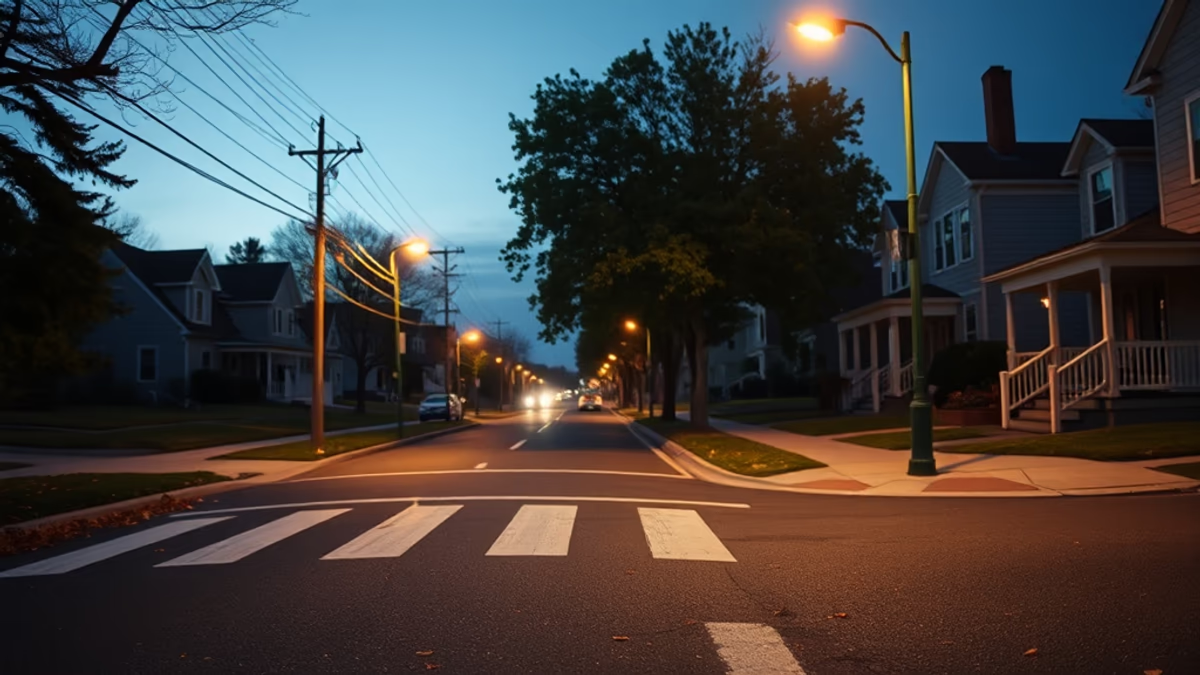
Long Island nightlife runs the spectrum: South Shore bar strips that run hard from happy hour to last call, North Shore village restaurants that close at 10, East End summer scenes that exist for three months and then go dark, and the year-round Nassau staples in between. This guide is for anyone making real plans — where to go, how to get home, and the realities of who’s responsible when something goes wrong.
The four LI nightlife scenes
Patchogue (South Shore, central Suffolk) has emerged as Long Island’s most-walkable downtown nightlife. Main Street has a dozen restaurants and bars within four blocks. The Patchogue Theatre books national touring acts. The Brickhouse Brewery is the locals’ anchor. From the LIRR Patchogue stop, every door on the strip is within a 10-minute walk.
Huntington Village (North Shore, western Suffolk) is the higher-end North Shore scene. New York Avenue and Wall Street have restaurant clusters with real cocktail programs — Crew, Black & Blue, Bistro Cassis, Honu Kitchen. The Paramount books touring music. LIRR Huntington station is a 5-minute walk to the village. Parking on Main Street is free after 6 PM but fills by 7:15 on weekend nights.
Long Beach West End (South Shore, Nassau, beach town) is Long Island’s clearest car-free nightlife. Three blocks of bars and restaurants on West Beech Street — Minus5 Ice Lounge, Sloppy Tuna, Joe’s of West End, rooftop bars on the boardwalk side. LIRR Long Beach is direct from Penn; the 8:00 PM train from Penn arrives at 8:55, perfect for dinner. Last train back to Penn is 12:38 AM weeknights, 1:38 AM Saturdays.
East End summer corridor (Hamptons + Montauk) is the scene that only runs Memorial Day through Labor Day. Surf Lodge, The Crow’s Nest, the Topping Rose House bar in Bridgehampton, Tutto Il Giorno in Sag Harbor. The driving distances are real (90+ minutes from western Long Island). Jitney bus + Uber-to-and-from-the-stop is the most realistic non-driving plan.
How to get home
Long Island Rail Road is the move when it works. Patchogue, Huntington, Babylon, Long Beach, and Bay Shore all have late-night LIRR service on Friday and Saturday nights — the last trains run between 12:30 and 2:00 AM depending on the branch. Check the actual schedule the day of your plans; LIRR runs reduced service on holidays and during construction windows.
Rideshare on Long Island is surge-prone. Uber and Lyft both cover the whole island but pricing is dramatically uneven. Friday nights in the Hamptons in July can see surge multipliers of 3-4x. Patchogue and Huntington Village rideshare prices are more predictable (1.2-1.5x typical), but late-night supply in Suffolk County thins out after 1 AM. Pre-booking the return ride during dinner is the locals’ move — even if you have to estimate the time.
Designated drivers still matter. The most reliable plan, especially in groups of 3+, is rotating who’s not drinking. Many LI venues offer free non-alcoholic drinks to confirmed designated drivers — ask the bartender when you sit down. Some Hamptons restaurants will comp the DD’s entire meal in groups of four or more during peak summer.
Local taxi services exist outside rideshare. Long Island still has working taxi companies in most towns — Patchogue Cab, Huntington Taxi, Sag Harbor Taxi. The pricing is often more predictable than peak-surge Uber. Worth saving the local number before you go out.
The bar that overserved them
Long Island has a real problem with drunk driving — particularly along the LIE service road, Sunrise Highway, and the East End back roads in summer. The state’s DWI penalties are well-documented. What’s less commonly understood is that the bar or restaurant that continued serving a visibly intoxicated patron can also be civilly liable for the injuries that patron then caused. The framework is called New York dram shop liability, and it operates in parallel with the criminal DWI case against the driver.
Under New York’s Alcoholic Beverage Control Law §65, a licensed establishment cannot lawfully sell or serve alcohol to a visibly intoxicated person, or to anyone under 21. When that happens and the patron then causes an accident, the injured third party has a direct civil claim against the establishment. This is independent of the claim against the drunk driver themselves.
In practice, bar liability matters because commercial liquor liability insurance policies frequently carry per-occurrence limits of $1 million or more — substantially higher than the minimum auto coverage many drivers carry. For severe injuries, the bar’s coverage can be the difference between partial and full recovery.
Notable Long Island dram shop cases
The cases that establish what dram shop liability looks like in practice rarely make headlines, but the patterns repeat. The following are scenarios that have been litigated on Long Island in the past 24 months (anonymized; results from cases handled by the Law Office of Jason Tenenbaum, P.C.):
Patron served 9 drinks over 4 hours at a South Shore tavern; bartender's deposition confirmed slurring + stumbling before patron left. Crossed centerline on Route 25, head-on collision. Spinal fusion for the third-party victim.
Restaurant served alcohol to a 19-year-old without checking ID. Patron caused a T-bone collision on the LIE service road. ABC §65(1) violation established liability per se — no visible-intoxication proof needed for service-to-minor cases.
Nightclub continued serving an already-intoxicated patron in violation of ABC §65(2); patron struck a pedestrian. Surviving family recovered from both the nightclub's commercial liquor policy and the driver's auto coverage.
Adult homeowner served alcohol to underage guests at a graduation party; 20-year-old guest caused a rear-end collision on Sunrise Highway. Common-law social-host liability applied alongside the dram shop theory.
The throughline: bar receipts, surveillance footage, and bartender depositions are the evidence that turns a $50,000 case into a $2 million case. None of that evidence survives 60 days unless someone formally preserves it.
Practical: planning a night out
Before you go:
- Decide who’s driving, taking LIRR, or rideshare-ing — agree on it before drinks start
- Save the local taxi number as a backup
- If LIRR, screenshot the last-train time for your branch
- If driving, eat real food before drinks (not just “we’ll order something at the bar”)
At the bar:
- Water in between drinks isn’t a meme — it’s the actual difference between feeling okay and not
- Bar staff are generally good about flagging if you’re moving too fast; don’t take offense
- Group plans tend to drift; check in with the designated driver around 11 PM
Getting home:
- If your rideshare price tripled, wait 15 minutes before booking — surge often drops
- LIRR last trains often have a 10-15 minute grace if you message the conductor, but don’t bank on it
- If you’re at all uncertain about driving, don’t. The car will be fine in the lot overnight; the same isn’t true for everyone on the road.
When something goes wrong
If you’ve been hit by an impaired driver on Long Island, the first 48 hours matter most:
- Document the scene if you're physically able — photos of vehicles, conditions, the other driver's apparent state. Phones make this trivial; the photos become evidence months later when memories blur.
- Make sure police respond and conduct field sobriety testing if intoxication is apparent. The officer's report + any DWI charge become the foundation of the civil case.
- Get medical evaluation immediately, even if injuries seem minor. Contemporaneous medical records carry significant weight in any subsequent Long Island car accident lawyer claim; gaps in treatment are routinely used by defense insurers to argue injuries weren't serious.
- Note where the driver was drinking if you have any information about it — friends, witnesses, the responding officer's investigation. This is the trigger that opens the dram shop case in parallel.
The most time-sensitive piece is bar surveillance preservation. Footage cycles on 30-60 day overwrites and once gone is permanently unrecoverable. Specialized counsel familiar with New York’s dram shop framework can act on this immediately.
For an in-depth treatment of how dram shop claims work in New York — ABC §65 mechanics, visible intoxication evidence, dual recovery from auto and commercial policies, statute of limitations — see Jason Tenenbaum’s full Long Island dram shop accident lawyer reference. JTNY Law is our editorial partner on safety + legal context across the network.
Frequently asked
What is dram shop liability in New York? Dram shop liability is the civil-law principle that a licensed alcohol vendor (bar, restaurant, tavern, nightclub, catering hall, or liquor store) can be sued by a third party who was injured by a patron the vendor unlawfully served. In New York, the framework is Alcoholic Beverage Control Law §65, which prohibits service to a visibly intoxicated person or to anyone under 21. The drunk driver themselves has no dram-shop claim — only the injured third party does.
How long do I have to file a dram shop claim in New York? Three years from the date of the accident under CPLR §214 for personal injury claims; two years from the date of death under EPTL §5-4.1 for wrongful death. But the practical deadline is much shorter: bar surveillance footage is overwritten in 30-60 days, point-of-sale records cycle on similar timelines, and servers change jobs. Preservation letters need to go out within days of the accident.
Does a bar’s insurance actually cover dram shop claims? Yes — and the coverage is often substantially higher than the drunk driver’s auto coverage. Commercial liquor liability policies commonly carry per-occurrence limits of $1 million to $3 million, vs. the New York minimum auto coverage of $25,000/$50,000. In catastrophic-injury cases, the bar’s commercial policy can be the difference between partial and full recovery. See Jason Tenenbaum’s dram shop reference for the full insurance + recovery framework.
Related on This Long Island:
- West End Friday nights — Long Beach
- Surf Lodge Tuesday DJ set
- The Paramount Friday comedy
- Patchogue village guide
- Huntington village guide
Related on JTNY Law:
- Jason’s deep-dive on ABC §65 + bar liability litigation — the legal-framework companion piece Jason wrote for our partner exchange
This guide is editorial and not legal advice. Every case is unique. If you’ve been involved in an alcohol-related accident, consult a qualified New York personal injury attorney about your specific situation.